How to Cover Ivysaur’s Weaknesses on a Modern Pokémon Team
Learn Ivysaur’s modern Grass/Poison weaknesses, resistances, and neutral matchups, then check teammates against its four defensive weaknesses.
On this page
Ivysaur has been around since the first generation, and yet there’s still so much that can be said about it.
Ivysaur’s defensive matchup
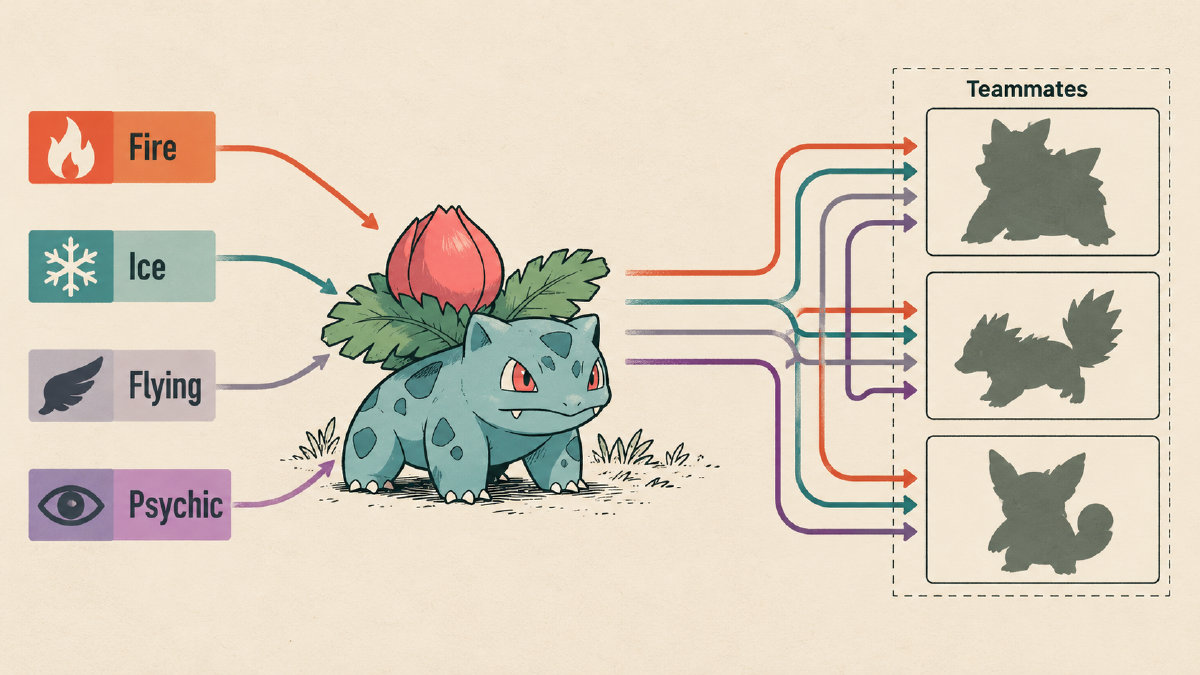
The second stage of the Bulbasaur evolution line is Grass/Poison-typed, which means it’s weak to Fire, Ice, Flying, and Psychic. Its typing is unchanged, and under the modern main-series chart, Fire deals 2× damage. The defensive matchup for Grass/Poison-type Pokémon remains relatively consistent: Ground and Bug deal damage at 1×; Water, Electric, Fighting, and Fairy attack it at ½×; Steel at 1×; Grass at ¼×; and Ice, Flying, and Psychic at 2×. In short, Ivysaur has no weaknesses against Grass or Poison.
So why does Ivysaur even matter? Well, it turns out that Ivysaur’s resistances may help defend against attacks from other Pokémon, especially if you’re playing competitively. For example, a Grass-type move would be super effective against Water, Ground, and Rock, but Ivysaur would only offer a small benefit against those types. But if Ivysaur’s also resistant to some type of attack, then it could help protect teammates by reducing their chances of taking damage.
Let’s take a look at Ivysaur’s combined defensive matchup. As you can see, Ivysaur isn’t super weak to anything, which makes sense considering how it’s typed. But it is vulnerable to four different types of moves: Fire, Ice, Flying, and Psychic, all of which deal 2× damage. So what’s the solution?
Covering Ivysaur’s weaknesses
Well, maybe we can use another Grass-type to cover Ivysaur’s weaknesses. If you have one Grass-type Pokémon, then Ivysaur can be covered as well. Alternatively, you might consider a Water or Ice-type team member to help protect your Ivysaur.
If you want to try something more creative, there’s an online calculator that helps determine what kind of combination of Pokémon you need to cover each weakness. And of course, there’s also a tool where you can input the Pokémon you’re using and get suggestions on who else to pair with them to create the best possible matchups.
Ivysaur’s coverage checklist
Let’s start off with what Ivysaur covers for us in terms of coverage. Since Ivysaur is a Grass/Poison-type, it’s not particularly good at covering the weaknesses of other Pokémon. However, its resistance against some attacks might be useful to teammates.
First, check whether potential teammates resist the attacks Ivysaur is weak to: Fire, Ice, Flying, and Psychic. That way, you can switch them into those attacks without taking as much damage. You can use a dual-type calculator to figure this out.
Then check whether the entire team shares any weaknesses. Obviously, that’s not great. The fewer repeated weaknesses, the better, because then it’s harder to switch into your opponents’ attacks. Again, the team-weakness checker can help here.
You’ll need to decide whether you’d like to add another Grass or Poison-type Pokémon. While these two types do share weaknesses, you’ll find that there are plenty of Pokémon that are resistant to Grass, including Dragon-types. Similarly, while Poison-type attacks deal neutral damage to Ivysaur, you should check each candidate’s complete typing for the resistances or immunities your team needs. Both are viable choices, though.
Another option is to add a Water or Ice-type to the team. Check each candidate’s complete typing against Fire, Ice, Flying, and Psychic before counting it as protection for Ivysaur. However, there are some disadvantages associated with adding a Water-type, such as the fact that it’s weak to Electric attacks. Similarly, check an Ice-type candidate’s combined defensive matchup rather than assuming it covers Ivysaur’s weaknesses. Reduced type effectiveness alone doesn’t guarantee a safe switch or a winning matchup.
It seems like there’s a lot going on when building a modern Pokémon team, and I’m glad there are tools to make sure you’re making the right decisions.
Sources
Check your team
Explore type matchups and compare shared weaknesses.
Open team builder →