How to Cover Marshadow’s Weaknesses on a Modern Pokémon Team
Check Marshadow’s Fighting/Ghost weaknesses, resistances and immunities, then identify defensive coverage needs for a modern main-series team.
On this page
A modern Pokémon team is made of multiple members, and each has a type. A common way to evaluate the strength or weakness of a particular matchup is with a TypeChart. This allows us to calculate what damage one Pokémon deals versus another. We also use this in order to check how well a certain Pokémon’s weaknesses are covered by others.
Marshadow’s Type Weaknesses
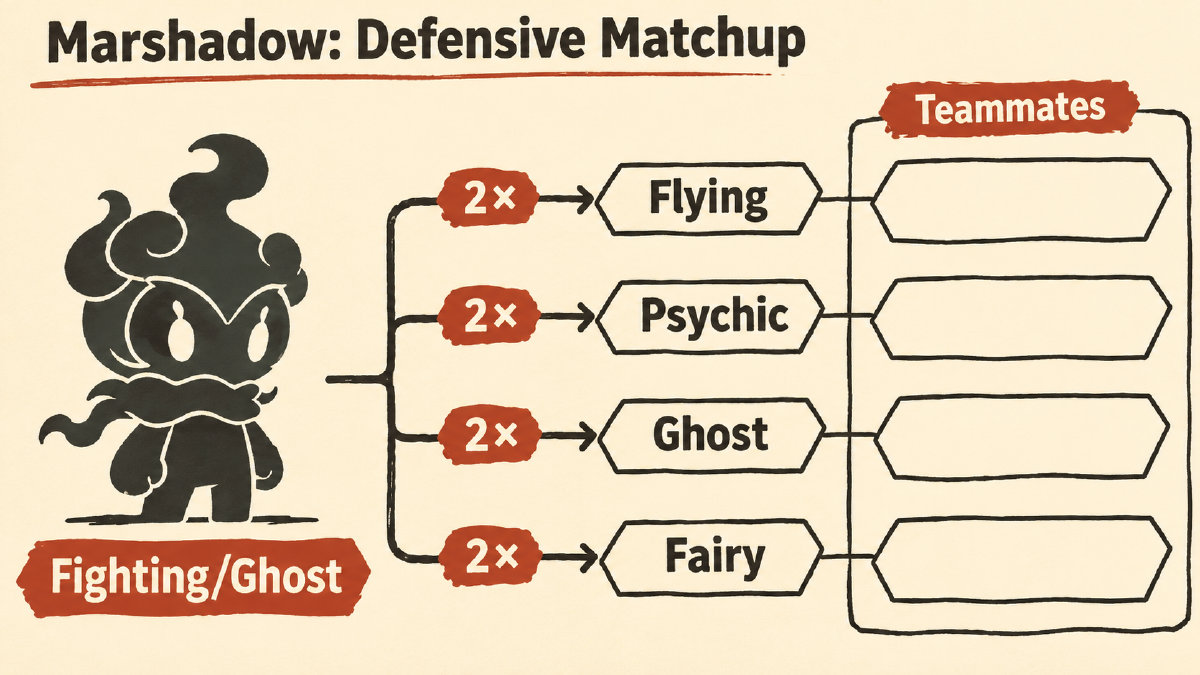
Let’s begin at the beginning: Marshadow is dual-typed Fighting/Ghost. Marshadow was introduced in Generation 7. When you’re looking at the effectiveness of your team against another team, it’s not enough to consider only one of the types; instead, you must consider both. Because the two effectiveness multipliers multiply, Marshadow suffers from several shared weaknesses. Let’s break them down:
Flying: 2×
Psychic: 2×
Ghost: 2×
Fairy: 2×
None of those attacks are a double weakness, so no matter what attack you bring to the table, they all exploit Marshadow’s baseline weaknesses in similar fashion.
Marshadow’s Defensive Profile
Now let’s look at Marshadow’s defensive profile. If I was playing a game where I had to choose between just using Marshadow alone, or some combination of other Pokémon, then I’d want to make sure that I could cover Marshadow’s remaining weaknesses. In the game of Pokémon Go, Marshadow can actually be useful because of its resistance to Poison, and its ability to switch in behind other Ghosts. But since we’re talking about a battle team, here are the rest of Marshadow’s defensive profile:
Poison and Rock: ½×
Bug: ¼×
Normal and Fighting: 0×
Fire, Water, Electric, Grass, Ice, Ground, Dragon, Dark and Steel: 1×
You’ll notice that these multipliers combine both of Marshadow’s types, but they’re a representation of relative type effectiveness, not a complete damage calculation. The difference between reduced damage, immunity and neutral effectiveness is critical when choosing teammates to help defend against the most effective threats. You should remember that multipliers are one part of the overall assessment of damage, not the whole story.
Screening Teammates for Reciprocal Coverage
Because of this, teammate screening needs to take place separately for resistance or immunity to each of the four attacking types: Flying, Psychic, Ghost and Fairy. Flagging any shared weaknesses means that there are potentially overlapping areas in the defenses of your team, meaning that you may need to cover those areas with different Pokémon. But the benefit is that it opens up possibilities for reciprocal protection from Marshadow itself.
When evaluating whether a proposed teammate will fit into the existing team composition, you can begin by checking their combined defensive typing. Then look for repeated weaknesses across the entire team, making sure that there are opportunities for reciprocal coverage from either the other Pokémon or Marshadow itself. Finally, ask if there are any other Pokémon who might help fill those gaps.
In terms of planning, it helps to define criteria based on type interactions first and foremost, keeping in mind the type matchups that will be important within a given format. Otherwise, you risk building a team that doesn’t work well together simply because they don’t cover the right weaknesses.
As always, the suitability of a specific Pokémon or a team composition will depend on how well the team covers each other’s weaknesses and how safe switching will be conditional upon more than just type coverage. However, you can still think through potential teams and combinations by creating conceptual TypeChart comparisons between individual match-ups, as well as combinations of various possible teams.
Comparing Type Effectiveness With TypeChart
TypeChart provides a dual-type calculator, allowing you to compare the two types against each other. For example, Grass/Ground takes 4× damage from Ice, and 0× from Electric.
TypeChart also provides a team weakness planner, which can be used to see what damage is done to the team as a whole by other teams. It’s possible that the team would not even be able to handle the attacks. Alternatively, you might try to see what sort of damage a team would do to Marshadow’s team.
There are no hands-on tests here — this article uses the information provided in the above-mentioned tools and breaks them down for you. Just know that while these results are accurate in terms of type effectiveness, they aren’t necessarily a guide towards whether you should play a certain Pokémon, and certainly not whether you should build a certain team around it.
Sources
Check your team
Explore type matchups and compare shared weaknesses.
Open team builder →