How to Plan a Bulbasaur Team in Scarlet and Violet
Plan around Bulbasaur’s Grass/Poison typing in Scarlet and Violet, with its weaknesses, resistances, evolution levels and team coverage priorities.
On this page
Bulbasaur is a common Pokémon in Pokémon games, but its coverage has evolved. The evolution path doesn’t change how it contributes to a defensive or offensive team, though.
Bulbasaur Weaknesses and Resistances
The first thing you need to do when considering adding Bulbasaur to your team in Scarlet and Violet is to check the weaknesses of other Pokémon to determine if they’ll have enough defenses. You can use an online tool like TypeChart (which I’ve written about before) as a starting point.
In general, Bulbasaur’s weaknesses are Fire, Ice, Flying, and Psychic types. These attacks would hit Bulbasaur with 2× effectiveness. On the other hand, Bulbasaur’s resistances are Water, Electric, Fighting, Fairy, and Grass types. Water, Electric, Fighting, and Fairy attacks will hit it for ½× effectiveness, while Grass attacks hit for ¼× effectiveness. If an attack hits with no added effectiveness, that’s considered “neutral,” and it will do full damage.
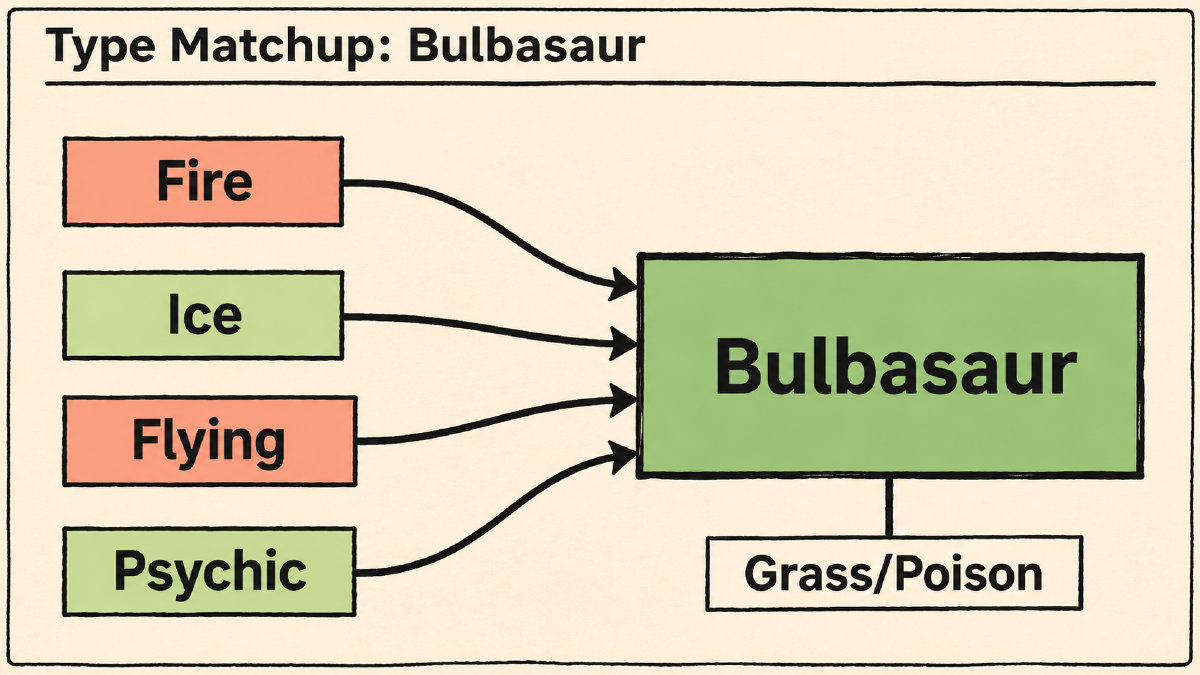
If you’re looking at what Bulbasaur could cover against, keep in mind that Bulbasaur does not have any immunity to any of these types. So while it might be able to survive a number of different attacks, Bulbasaur isn’t immune to anything. Bulbasaur’s Grass- and Poison-type attacks are super effective against Ground, Rock, Water, Grass, and Fairy Pokémon, though that doesn’t mean Bulbasaur will always survive an attack from those types.
Base Stats and Available Moves
TypeChart will tell you how much Bulbasaur can contribute to the battlefield. However, you should consider the level-up moves it can learn alongside the TMs available. Its base stats are 45 HP, 49 Attack, 49 Defense, 65 Special Attack, 65 Special Defense, and 45 Speed. For example, Leech Seed and Sleep Powder aren’t accessible until levels 9 and 15, respectively, so if your Bulbasaur is lower than those levels, then those moves won’t be accessible yet. Similarly, Energy Ball is one of the few TMs that Bulbasaur can learn. It’s also available via the move list as TM119, Sludge Bomb as TM148, and so on.
The ordinary evolution chain includes Grass/Poison throughout, including Bulbasaur, Ivysaur, and Venusaur. Bulbasaur evolves at level 16, then Ivysaur at 32. So if you’re thinking about building around the evolution, the coverage remains similar: the same four weaknesses.
Finding Bulbasaur in Scarlet and Violet
Wherever you find a Bulbasaur in Pokémon Scarlet and Violet, remember that you can still access the Pokémon through transfers, trades, or even by completing tasks within the League Club itself. Wild Bulbasaur requires The Indigo Disk’s Coastal Biome upgrade: 3,000 BP after unlocking League Club spending tasks. HOME transfers and trades don’t require this. But don’t worry too much; the game makes it easy for you to build your own team.
Sources
Check your team
Explore type matchups and compare shared weaknesses.
Open team builder →