How to Cover Chandelure’s Weaknesses on a Modern Pokémon Team
Check Chandelure’s five weaknesses, resistances and immunities, then plan teammate coverage while accounting for Flash Fire separately.
On this page
Chandelure, the spectral flame Pokémon, has some of the worst defensive typing in the main series. A ghost and fire-type, it is weak to five types: water, ground, rock, ghost, and dark. The question for a modern trainer using this Pokémon is, how can you cover those weaknesses? What teammates should you pick, who can help neutralize or counter those vulnerabilities?
While a modern team may not require any particular type to be immune to another, each member will contribute their own typing to the overall composition. You must balance what your teammates’ typings are, as well as what weaknesses they’ll bring to the team.
Chandelure’s Defensive Typing and Flash Fire
Let’s start with Chandelure itself. Chandelure’s combined defensive typing gives it immunities to normal and fighting, neutral damage from electric, flying, psychic, and dragon, and resistances or weaknesses against all others. It also provides ¼× resistance to bug attacks, as well as ½× resistance to fire, grass, ice, poison, steel, and fairy.
However, remember that just because Chandelure is resistant or immune to an attack doesn’t mean that a switch will always be safe. For example, if an opponent uses a fire-type move and you’re facing Chandelure, then Chandelure will take half damage from such an attack. However, if Chandelure has Flash Fire, then it absorbs that fire-type move and takes no damage from it. If Chandelure is still viable, then the battle continues; otherwise, you’ve lost the game.
That brings up Flash Fire, which allows Chandelure to absorb any fire-type moves that it receives and strengthen its own fire-type moves. But Flash Fire provides immunity through an ability effect, separate from Chandelure’s typing. Rather, it changes how the typing matchup works for one specific scenario: when a fire-type move hits a Chandelure equipped with Flash Fire, it absorbs that attack instead of taking damage. That’s essentially turning the fire resistance into an immunity. Furthermore, the Flash Fire ability powers up the Chandelure’s own fire-type moves, increasing their effectiveness.
Screening Teammates and Reciprocal Coverage
The process begins with screening each prospective teammate, using TypeChart’s dual-type calculator to check how they interact individually. Then, you have to inspect their coverage, making sure they resolve any unresolved weaknesses. Afterward, check out whether any shared weaknesses exist across the team, then inspect how Chandelure itself helps by covering your teammates’ weaknesses.
If there are any weaknesses left, look to the other Pokémon in your team, checking their resistance or immunity against those attacking types. Does one or more of them already have that resistance or immunity?
Next, you can consider reciprocal coverage. How do Chandelure’s resistances and immunities match up against your teammates’ weaknesses? If Chandelure has any resistance or immunity to the types you’re looking to resolve, that’s good news, as it means Chandelure can help protect those weaknesses. Additionally, make sure that any teammates who don’t already provide coverage to those attacking types aren’t too weak themselves.
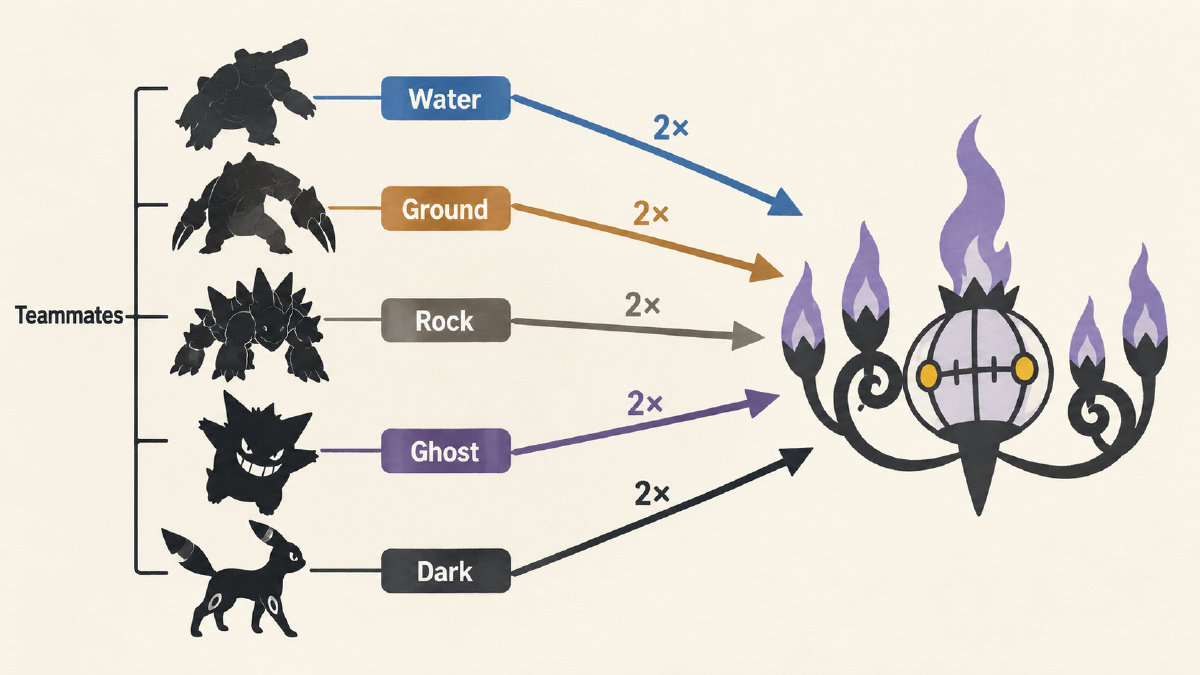
Flash Fire and the Rest of Your Team
Finally, we turn our attention to Flash Fire, a separate ability adjustment that affects only a Chandelure equipped with it. Again, the Flash Fire ability adjusts how the typing matchup looks, turning the resistance to fire-type moves into an immunity. This will allow Chandelure to deal with those types, but Flash Fire doesn’t affect how the rest of your team interacts with the opposing Pokémon.
Type-based defensive screening doesn’t necessarily prove that the battle will end in victory — unless every one of your Pokémon is immune to whatever the enemy throws at you.
Sources
Check your team
Explore type matchups and compare shared weaknesses.
Open team builder →