Wooper Weaknesses and Team Coverage in Scarlet and Violet
Compare Wooper and Paldean Wooper weaknesses, resistances, and Water Absorb in Scarlet and Violet to plan your team’s defensive coverage.
On this page
I’ve written about Wooper’s evolution before, but not how it affects the Pokémon’s defensive coverage. Let’s take a look at that.
Wooper Forms and Evolution
The two forms of Wooper in Scarlet and Violet are different from each other both in terms of their evolution paths and their typing:
Standard Wooper is Water/Ground, evolving into Quagsire at level 20.
Paldean Wooper is Poison/Ground, evolving into Clodsire at level 20.
In both cases, the evolved form has the same type as its starter: Quagsire is Water/Ground, and Clodsire is Poison/Ground.
When looking at a Pokémon’s weaknesses, there are three things to consider:
-
What types does the Pokémon have?
-
What abilities does it have?
-
What moves does it use?
Let’s start with just the types.
Standard Wooper Weaknesses and Water Absorb
Standard Wooper is Water/Ground. That means it has resistances against Fire, Poison, Rock, and Steel (½×), an immunity to Electric (0×), and a weakness to Grass (4×). Its only weakness is Grass. It’s immune to Electric-type attacks and takes reduced damage from the types it resists. But if it has the ability Water Absorb, it restores HP when hit by Water-type attacks instead of taking damage. Without that ability, Water-type attacks deal neutral damage. However, this isn’t something you need to worry about unless your opponent uses Water-type moves against it.
The Paldean form of Wooper is Poison/Ground. This gives it weaknesses to Water, Ice, Ground, and Psychic (2×), neutral damage from Grass (1×), and an immunity to Electric (0×), before abilities come into play. It also has resistances against Fighting, Bug, Rock, and Fairy (½×). Like the standard form, it’s immune to Electric-type attacks and takes reduced damage from the types it resists. And like the standard form, it can have the ability Water Absorb, which restores HP when hit by Water-type moves instead of taking damage. It doesn’t need Water typing for that.
Choosing Wooper Based on Team Coverage
So what does all of this mean for our choices? Well, first off, we should remember that the Paldean form takes neutral damage from Grass instead of being weak to it. So if we’re choosing between the two forms, we might want to choose the one whose weaknesses are more easily covered by our team. For example, if we have a teammate who can handle Grass attacks, then we’d probably prefer the standard form. If we don’t, then maybe the Paldean form would be better. For the Paldean form, we should cover Ice, Ground, and Psychic attacks, plus Water unless it has Water Absorb.
However, we should also remember that the Paldean form has a few advantages over the standard form. First off, it has a few more resistances. This means that it’ll be less likely to take damage from certain types of attacks. Second, it has the ability Water Absorb, which can help us out if we’re facing Water-type attacks. But both forms can have Water Absorb, so we should check the individual Pokémon’s ability. It isn’t an advantage that only the Paldean form has. However, it has more weaknesses overall, even with Water Absorb.
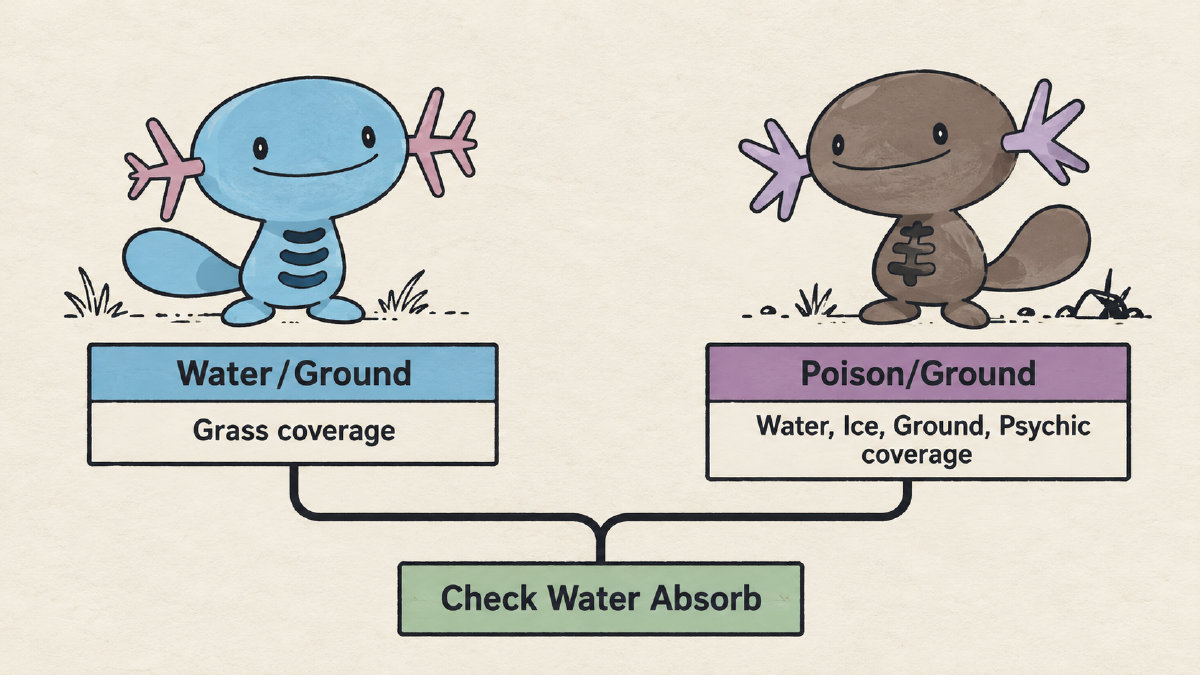
Ultimately, whether or not we should pick the Paldean form depends on what kind of team we’re building. If we’re going for a more balanced team, then the standard form might be better because it has fewer weaknesses. If we’re going for a team that can cover those weaknesses, then the Paldean form might be better because it has a few more resistances. Either way, it’s important to remember that neither form is universally better than the other. It really depends on what kind of team you’re building.
Sources
Check your team
Explore type matchups and compare shared weaknesses.
Open team builder →